
November 15, 2025
AI Frontiers: Six Systems Shaping the Next Decade of Enterprise Innovation
“Artificial Intelligence is no longer a tool—it’s an engine driving the next wave of enterprise transformation.”
The business landscape is evolving at an unprecedented pace. Organizations that leverage AI strategically gain not just operational efficiency, but a significant competitive advantage. Today’s AI systems are far beyond simple automation or predictive analytics. They are perceptive, reasoning, adaptive, and increasingly autonomous, capable of transforming every aspect of enterprise operations.
From agentic AI that independently makes decisions to industry-specific intelligence tailored for specialized domains, these technologies are redefining how businesses innovate, operate, and compete. Understanding these next-generation AI frontiers is critical for corporate leaders who aim to future-proof their organizations and harness the full potential of AI.
This article explores six interconnected AI frontiers that together define the next decade of enterprise intelligence, showing how they interrelate and build upon one another to deliver measurable business impact.
From Perception to Action: Agentic AI
The first frontier in enterprise AI evolution is Agentic AI. Traditional AI systems operate passively: they analyze data and provide recommendations or outputs based on programmed rules. In contrast, agentic AI systems are autonomous decision-makers that actively perceive their environment, evaluate possible actions, and execute the ones most likely to achieve desired outcomes. This shift transforms AI from a reactive tool into a proactive operational partner capable of driving business objectives independently.
Key Applications for Enterprise
- Customer support: Agentic AI can automatically triage and resolve customer issues without human intervention, escalating only the most complex cases.
- IT operations: AI systems can monitor infrastructure continuously, detecting anomalies, predicting failures, and autonomously implementing corrective measures.
- Supply chain optimization: Agentic AI can dynamically adjust inventory levels, logistics routes, and production schedules in real time, responding to fluctuations in demand, raw material availability, or transportation delays.
Real-World Example:
A logistics company deploying agentic AI to optimize delivery routes reduced fuel consumption by 20% while improving on-time delivery performance by 30%. The system monitored traffic patterns, weather conditions, and vehicle performance autonomously, continuously refining its decisions.
Strategic Value:
Agentic AI not only improves operational efficiency but also creates new possibilities for business models, enabling companies to explore automation in areas previously considered too complex for AI intervention.
Curious How Agentic AI Transforms Your Operations? Schedule A Consultation with Our AI Experts to Explore Autonomous Solutions Tailored to Your Enterprise.
Layering Reasoning: Cognitive AI
While agentic AI focuses on taking autonomous action, the next frontier, Cognitive AI, adds contextual reasoning and explainability. Cognitive AI doesn’t just suggest what to do; it helps organizations understand why a particular decision or action is optimal, allowing leaders to make informed choices in complex and high-stakes environments.
Enterprise Applications
Finance: Cognitive AI evaluates multifaceted risk scenarios, integrating regulatory requirements, market volatility, and operational data. The system not only predicts potential outcomes but also provides reasoning that auditors and compliance teams can validate.
Manufacturing: AI systems simulate production line adjustments, identifying bottlenecks, and evaluating the impact of changes on throughput and cost.
Healthcare: Cognitive AI interprets complex medical data sets to recommend treatment paths, while providing clinicians with transparent reasoning for each recommendation, supporting trust and compliance in critical decisions.
Real-World Example:
A multinational manufacturer used cognitive AI to simulate production scenarios. The AI identified an overlooked bottleneck in a multi-step assembly line, allowing the company to make proactive adjustments and avoid costly downtime. Over a year, this reduced operational inefficiencies by 15% and improved overall throughput.
Strategic Value:
Cognitive AI transforms enterprise AI from a tactical tool into a strategic advisor, enabling executives to make informed decisions that balance risk, opportunity, and operational efficiency. By combining autonomy with reasoning, organizations can implement AI that augments human judgment rather than simply automating tasks.
Adapting in Real-Time: Self-Evolving AI Systems
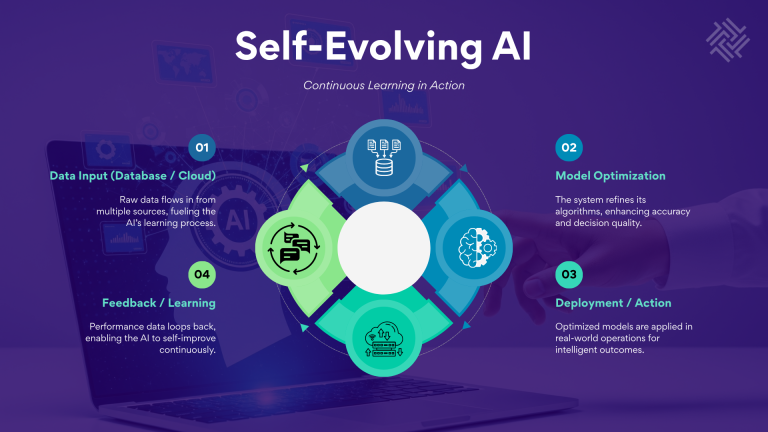
Cognitive AI sets the stage for Self-Evolving AI Systems, which represent a leap toward fully adaptive intelligence. Unlike static models that require manual retraining, self-evolving systems continuously learn from new data, interactions, and outcomes, adjusting their behavior in real time to improve performance.
Enterprise Applications
Industrial Automation: Equipment can optimize its own operational parameters autonomously, reducing downtime and improving efficiency.
Dynamic Pricing: Retail and e-commerce platforms can adjust pricing dynamically based on real-time demand, competitor activity, and inventory levels.
Customer Engagement: Virtual assistants and recommendation engines improve their accuracy and relevance as they interact with more users and receive feedback.
Real-World Example:
A logistics provider implemented a self-evolving AI system to optimize delivery routes. Within six months, the AI had learned traffic patterns, weather impacts, and vehicle performance nuances, resulting in a 25% improvement in delivery efficiency and significant reductions in fuel consumption.
Strategic Value:
Self-evolving AI ensures that enterprise systems remain adaptive in dynamic environments, maintaining performance even as market conditions, customer behavior, or operational contexts change. This capability is critical for businesses seeking continuous innovation and operational resilience.
Enterprise-Scale Integration: AI Operating Systems (AIOS)
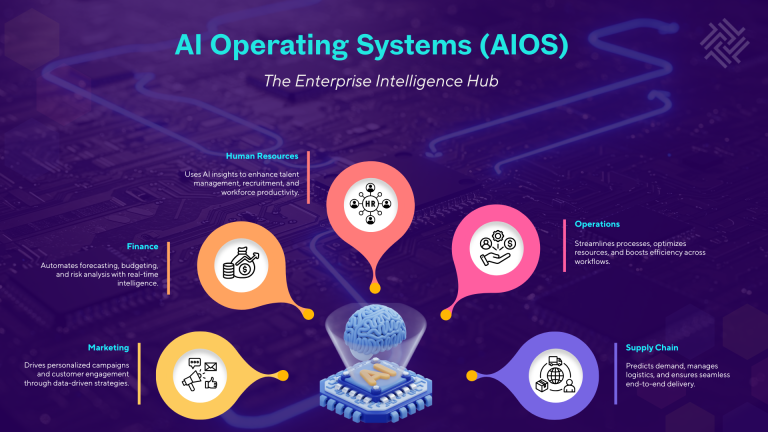
As AI systems become more autonomous, reasoning-driven, and self-evolving, enterprises need a framework to orchestrate these capabilities effectively. This is where AI Operating Systems (AIOS) play a critical role. AIOS integrates multiple models, connects workflows, and unifies data sources, ensuring consistency and scalability across the organization.
Enterprise Applications
Cross-Departmental Intelligence: AIOS centralizes insights from HR, finance, marketing, operations, and supply chain, providing a unified operational view.
Workflow Orchestration: Ensures that different AI modules collaborate effectively, preventing conflicting recommendations or siloed decision-making.
Strategic Decision Support: Facilitates alignment of AI-generated insights with organizational objectives, supporting both operational efficiency and strategic planning.
Real-World Example:
A global corporation used AIOS to coordinate predictive maintenance models, financial forecasting AI, and supply chain optimization systems. By harmonizing these models, the company increased operational efficiency by 20% and improved cross-departmental collaboration.
Strategic Value:
AIOS transforms disparate AI capabilities into an integrated enterprise intelligence ecosystem, enabling scalable, coordinated, and actionable insights that directly support corporate strategy.
Responsibility and Efficiency: Sustainable AI
As AI adoption grows, so do concerns about energy consumption, environmental impact, and sustainability. Sustainable AI focuses on optimizing computational efficiency, reducing carbon footprints, and aligning AI operations with ESG objectives.
Enterprise Applications
Low-Carbon AI Operations: Optimize model deployment and processing to minimize energy use.
Predictive Energy Management: AI predicts energy consumption patterns and reduces waste in industrial and corporate environments.
ESG Alignment: Embeds sustainability into corporate AI strategies, supporting compliance and brand reputation.
Real-World Example:
A technology firm implemented AI-driven energy management across its data centers. The system optimized workloads, reduced electricity usage by 35%, and maintained processing capacity, achieving both operational efficiency and sustainability goals.
Strategic Value:
Sustainable AI enables organizations to deliver AI-driven value without compromising environmental responsibility, creating a balance between operational performance and corporate social responsibility.
Precision and Specialization: Domain-Specific Intelligence
While general-purpose AI can address broad challenges, domain-specific intelligence delivers maximum value by tailoring AI to the unique needs of a particular industry or function. These models leverage industry-specific datasets, rules, and regulatory knowledge to optimize performance and compliance.
Enterprise Applications
Manufacturing: Predictive maintenance, quality control, and production optimization.
Finance: Fraud detection, risk management, credit scoring, and regulatory compliance.
Healthcare: Diagnostics, patient monitoring, treatment recommendations, and operational efficiency in hospitals and clinics.
Real-World Example:
A healthcare provider implemented domain-specific AI for radiology image analysis. Accuracy improved by 40% compared to generic AI, speeding up diagnosis, reducing human error, and enabling better patient outcomes.
Strategic Value:
Domain-specific AI ensures that enterprises leverage models that understand their operational context, delivering actionable insights that generic AI cannot provide. This is crucial for high-stakes industries where accuracy, compliance, and contextual understanding are essential.
The Interconnected AI Frontier
These six frontiers—Agentic AI, Cognitive AI, Self-Evolving Systems, AI Operating Systems, Sustainable AI, and Domain-Specific Intelligence—form a continuum rather than isolated capabilities:
- Autonomy enables action (Agentic AI).
- Reasoning refines decisions (Cognitive AI).
- Continuous adaptation ensures relevance (Self-Evolving Systems).
- Enterprise orchestration scales intelligence (AIOS).
- Sustainability embeds responsibility (Sustainable AI).
- Domain specialization maximizes value (Domain-Specific Intelligence).
Together, they represent a holistic blueprint for AI-driven enterprise transformation, blending operational efficiency, strategic intelligence, and sustainable innovation.
Ready to transform your enterprise with next-generation AI? Connect with our experts today and explore tailored AI solutions!
“The AI frontier is not a single technology—it is an ecosystem. Organizations that strategically adopt these interconnected systems will define the next decade of innovation.”
For corporate leaders, the pressing questions are:
- Which AI frontier aligns with your strategic priorities?
- How can these capabilities be integrated into existing operations to maximize ROI?
- Are you prepared to harness AI as a strategic partner, rather than merely a tool for operational efficiency?
Understanding and implementing these six AI frontiers is no longer optional—it is essential for enterprises aiming to remain competitive, resilient, and innovative in an AI-driven world.
Related Posts
September 17, 2025